Home / News / Prof. Jay Siegel has published a Science perspective entitled “Allotropy by Design: Carbon Nanohoops”
Prof. Jay Siegel has published a Science perspective entitled “Allotropy by Design: Carbon Nanohoops”

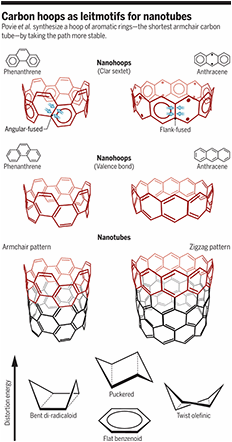
Professor Jay Siegel of Health Science Platform at Tianjin University recently published a perspective article in Science, explaining the design of man-made allotropes of carbon. Particularly, this perspective highlighted the recent discoveries in the Itami group, which were published in the same issue. In their research paper the Itami group described the synthesis of an angular-fused hoop structure. Such nanobelts have been long-standing targets since 1954. The molecular design and synthesis has made this type of molecule possible despite the present synthesis is accomplished in<1% yield.
1.png

In the article, Professor Siegel stated that “the crowning jewel of the work is that the authors obtained a crystal structure, which will no doubt inspire others to continue the pursuit of practical syntheses of this material and other variants. Having a crystal structure of a nanohoop provides a lead structure to motivate further detailed theoretical studies and generally infuses energy into the field of designer allotopes.”

Siegel also stated “Ultimately, the interest in practical applications will drive the search for efficient large-scale synthesis routes, similar to those found for the kilogram-scale synthesis of corannulene”.

Prof. Jay Siegel has published a Science perspective entitled “Allotropy by Design: Carbon Nanohoops”

Professor Jay Siegel of Health Science Platform at Tianjin University recently published a perspective article in Science, explaining the design of man-made allotropes of carbon. Particularly, this perspective highlighted the recent discoveries in the Itami group, which were published in the same issue. In their research paper the Itami group described the synthesis of an angular-fused hoop structure. Such nanobelts have been long-standing targets since 1954. The molecular design and synthesis has made this type of molecule possible despite the present synthesis is accomplished in<1% yield.

1.png

In the article, Professor Siegel stated that “the crowning jewel of the work is that the authors obtained a crystal structure, which will no doubt inspire others to continue the pursuit of practical syntheses of this material and other variants. Having a crystal structure of a nanohoop provides a lead structure to motivate further detailed theoretical studies and generally infuses energy into the field of designer allotopes.”

Siegel also stated “Ultimately, the interest in practical applications will drive the search for efficient large-scale synthesis routes, similar to those found for the kilogram-scale synthesis of corannulene”.